Products are chosen independently by our editors. Purchases made through our links may earn us a commission.
Credit:
Getty Images / olga_sweet
Why trust Reviewed?
Reviewed's mission is to help you buy the best stuff and get the most out of what you already own. Our team of product experts thoroughly vet every product we recommend to help you cut through the clutter and find what you need.
A great travel stroller should be compact, lightweight, and easy to fold for transport in cars, trains, or planes.
Look for models with good maneuverability, integrated carry options, and adequate weather protection like UPF canopies for comfortable travel.
Mothers can appreciate the need for a good travel stroller, especially when on the go. We tested lightweight strollers suitable for travel, everyday use, or use around town. Our goal was to find the best overall compact stroller: one that was lightweight, offered some storage, and still included extras, like a substantial canopy cover, decent storage space, and a reasonable recline. The strollers we tested range in price from $30 to $500, with the majority falling around the $200 mark.
Credit:
Reviewed / Christian de Looper
The Mamazing Ultra Air stroller is a lightweight, affordable option for parents of babies and toddlers, with safety straps, buckles, and padding.
Best Travel Stroller Overall
Mamazing Ultra Air Stroller
The Mamazing Ultra Air is a high-quality, lightweight stroller that's perfect for parents who don't want to spend more than they have to on a stroller for the road. Despite its lower price, the stroller has a durable build, helpful features like separated mechanisms for locking and unlocking, and is very lightweight.
On top of being lightweight, the stroller is designed to fold and unfold with one hand—something we found quite easy. That means you could fold it up and stow it while still holding your child in the other arm.
The stroller isn't built to support car seats or expandable for multiple children. And its ride is a little stiffer than higher-end models with inflatable tires. But it's still an excellent choice as either a secondary stroller or a travel stroller, or for parents with kids who only sometimes want to actually be in the stroller.
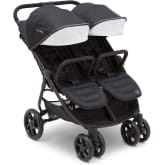
Jeep Destination Side x Side Double Ultralight by Delta Children
In the double stroller category, this side-by-side stroller was the winner, in no small part due to a host of fun extras and a reasonable price point. This stroller comes with a carrying strap, foot rests, reclining seats, dual swivel bars, full-coverage sun visors, five-point safety harnesses, and ample storage space for all your needs. Footrests are adjustable to facilitate naps on the go, and the good-sized tires make it easy to ride on most surfaces. But, like most side-by-side double strollers, it’s bulky, and much heavier than the other compacts I tested.
Here's a basic primer on the differences between types of strollers:
Standard stroller: This covers most strollers, and our top picks are found in our guide to the Best Strollers overall. They are average in size, typically weigh 20 lbs or more, and hold one child from about 6 months until he or she is about 50 lbs.
Double stroller: Double strollers, like the name suggests, hold two kids at once. Some models convert from a single to a double with the addition of a second seat and an adapter. Some doubles have seats side-by-side, while others have seats that are aligned vertically, all of which we tested to find the Best Double Strollers. Side-by-side models are less maneuverable in tight spaces but it's easier to get kids in and out, and you have more storage space typically.
Jogging stroller: These models typically have large wheels, often filled with air (like bike tires) and locking front wheels. They're designed for safely running with a child (or two children) in a seat. Locking the front wheel is essential because it helps prevent tip-overs if the front wheel were to hit a snag while you're running at full speed. Though Baby Jogger makes a jogging stroller (the Summit X3), it's worth noting most Baby Jogger strollers are not designed for jogging.
Lightweight/Umbrella stroller: Though new designs mean that many standard strollers are only barely heavier than these models, umbrella strollers typically weigh 15 pounds or less and fold up compactly into a long, narrow shape (like an umbrella). These models are great for travel, or if you have an older child who doesn't need a stroller all the time. All the models in this guide are umbrella/lightweight strollers.
You May Still Want a Second Stroller
Umbrella models are great for travel or in a pinch, but they don't make great primary strollers for most people. The biggest reason is they typically do not accept infant car seats the way a standard stroller will, which means they aren't useful until your baby is closer to 6 or 7 months and can sit on their own safely.
You can get around this by getting one of the few umbrella models that do accept infant car seats (and buying a compatible one), or picking up something like the Baby Trend Snap N Go which is a "caddy" that basically turns a compatible infant car seat into a stroller. Once your baby grows out of the infant car seat and can sit up safely, just use the lightweight model as normal.
Umbrella Models Often Lack Storage
Though our top pick offers a decent amount of storage, umbrella models often have little or no storage at all. We note this for all models where it's relevant in this guide, but if you get one without enough storage you're going to have to game plan what you do and don't bring with you.
Umbrella Strollers Fold Up More Compactly
Our top pick for this guide is not exactly an umbrella model, because it collapses into a square, rather than long and skinny (like an umbrella). In reality, there's very little difference between the two. The Joovy Kooper is just as light as most umbrella models, it has more storage, it's more maneuverable, it's much easier to fold, and it travels exceptionally well.
What Makes a Stroller Good for Travel
Compactness
A great travel stroller needs to be able to come with you when you travel. If you know you'll be taking your stroller in the car, on the train, or on the plane, you want a stroller that can fold down quickly and easily to fit into the space available. (This pays off if you need to store your stroller in a cramped hotel room, too.) If you always fly a certain carrier, check to see if your model will fit in the overhead bin space, and if you always take the same car on your adventures, a quick check of the trunk dimensions can give you an idea of how big or small your stroller should be. Strollers with one-hand, umbrella-style folds or tri-fold capabilities can save time and luggage space.
Weight and Carry Options
Heavier strollers are generally more durable, but pushing them through city streets or up a plane gangway can be a burden. The best travel strollers are lightweight enough to go up stairs easily, even with kids in them, but durable enough not to rattle apart over cobblestones. (We recommend looking for models that weigh in under 15 pounds.) And no matter the weight, strollers that come with integrated carry options — shoulder straps, backpack modes, or integrated handles — make riding buses and getting around town much easier.
Maneuverability
Wheeling through train stations, between restaurant tables, and around sightseeing crowds is easier with a nimble stroller. Front-wheel swivel locks make a measurable difference is how easy it is to get around: swivel mode is best for airports and malls, where tight turning and dodging around foot traffic is frequent, but being able to lock the front wheel is a lifesaver on uneven surfaces like gravel and tiles. Look for dual-wheel suspension, rubber tires, and shock absorbers for smooth pushing.
Weather Protection
If you'll be spending all day sightseeing, you never know when the weather might change. Sun canopies with UPF protection, rain covers, and ventilation panels all make a big difference in how comfortable your kids can be in changing weather.
How We Tested
Hi, I’m Hannah Selinger. I’m a freelance writer and I live in East Hampton with my family—which includes two children under 4. My reviews include my own life with two young children, and are informed by my own experiences with single and double strollers. I can’t tell you whether or not there is a perfect stroller on the market (and a lot of friends have asked me this question, as I have embarked on this quest for perfection), but I can tell you that the best baby item I can recommend to a first-time parent is definitely a cordless vacuum cleaner.
I have owned five or six strollers since having children, from joggers to ultra compacts to stick strollers to side-by-side doubles to convertible singles with rumble seats. I know the mistakes I’ve made and the things I would do differently, all of which is now in my bank of information, which I can draw from anytime a parent asks me what they should do. The first thing I did in this testing procedure was make a list of the strollers I was interested in sampling, based on my own experience with strollers, as well as the strollers we initially tested in our previous round of testing in 2018. Then, I had strollers sent, en masse, to my house.
And I mean truly mean en masse. At one point, 21 strollers languished in the basement—and those were just the ones sent by distributors. Never mind the ones I already owned. I opened each box, assembled the strollers, strapped each kid in, rode them around the living room, took pictures, took them on rides around the neighborhood, and then entered data into the testing scoresheet. Finally, I took them down to my basement, while my husband seethed and asked me when—if ever—I would be done with Project Strollergate. (For the last part of the procedural test I attempted to put them on a high basement shelf.) My final assessment was based on assembly, weight, size, how easily the stroller folded, maneuverability, and a few other statistical factors.
Prices were accurate at the time this article was published but may change over time.
The product experts at Reviewed
have all your shopping needs covered.
Follow Reviewed on Facebook,
Twitter,
Instagram,
TikTok,
or Flipboard for the latest deals, product reviews, and more.
Christian de Looper is a consumer tech journalist with over a decade of experience. De Looper has covered all areas of the consumer tech industry, from smartphones to smart homes — and has attended all of the major trade shows, including CES.
De Looper has always been interested in consumer technology, but his love for gadgets and electronics blossomed into a full-blown passion when he started writing about it while completing his degree in audio production.
Since then, he has written for many of the top tech publications, including Digital Trends, Tom’s Guide, TechRadar, and many more. He loves getting his hands on all of the latest gadgets, but when he’s not reviewing tech, he can be found hanging out with his family or producing music.
Hannah Selinger writes about parenting, politics, food, wine, travel, real estate, and more. A graduate of Columbia University, Emerson College’s Master of Fine Arts program, and the French Culinary Institute, Hannah now lives in East Hampton, New York with her husband, two sons, two dogs, and two tortoises. Her work has appeared in The New York Times, The Washington Post, The Wall Street Journal, The Cut, Slate, Eater, CNN Travel, Wine Enthusiast, and more.
Our team is here to help you buy the best stuff and love what you own. Our writers, editors, and experts obsess over the products we cover to make sure you're confident and satisfied. Have a different opinion about something we recommend? Email us and we'll compare notes.